Why Does My Backyard Flood? A Central TexasHomeowner's Quick Self-Diagnosis
Water pools in your yard after heavy rain and you've accepted that some kind of drainage issue is going on — but why is it happening, and where do you even start? Clay-heavy soils across Central Texas cause drainage headaches for homeowners from Seguin to Buda, Austin to Georgetown, and everywhere in between. You're not alone.
Before you pick up the phone, a little poking around your yard on your own can give you good insight into what's going on. Here's a simple, three-step self-diagnosis to get you started.
Step 1: Identify Where Water Is Pooling
The first step is to determine where water is actually collecting. The next time a storm rolls through, slip on your boots and step outside for a few minutes. Walk around and take note. Look out for:
Standing water in low spots — shallow depressions where water just sits long after the rain stops.
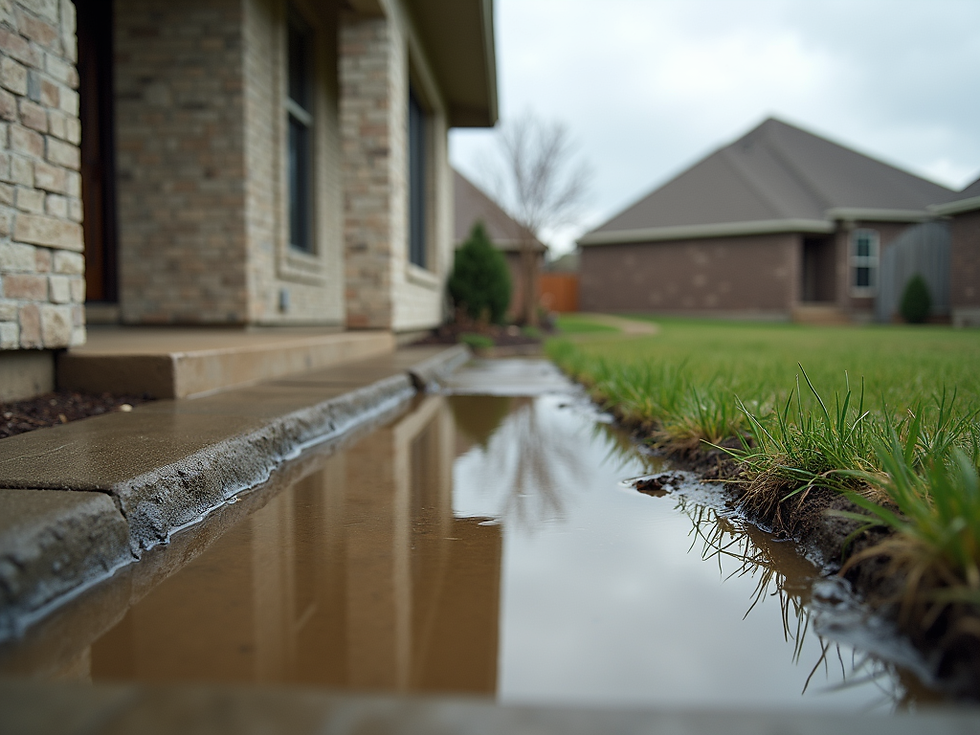
Water collecting near the foundation — pooling at the base of your home is a red flag. Central Texas clay soil expands and contracts, and over time that moisture can lead to foundation cracks and expensive repairs.
Muddy areas that stay wet longer than the rest of your yard — saturated soil that won't dry out may point to subsurface water issues or poor absorption.
Water flowing toward patios, sidewalks, or driveways — water should flow away from hardscapes, not toward them.
The main thing you're figuring out is whether water is moving toward an exit — the street or a drainage ditch — or just hanging out in your yard with nowhere to go. Take photos during or right after it rains. Once everything dries up, it's easy to forget what you saw.
Step 2: Clock How Long Water Sits
Next, note how long the water actually sticks around. Every yard holds some water after a heavy rain, and that's totally normal. The concern kicks in when water remains long after the skies have cleared. As a general rule:
Water that drains within a few hours isn't a cause for huge concern.
Water remaining for 24 hours or more usually means there's a drainage issue going on.
Water that sits for 48+ hours suggests a more serious problem that should be addressed.
Check the photos you took to gauge how long the water lingered. It's the best way to judge the severity of what you're dealing with.
Step 3: Take a Look at Your Grading
A lot of homeowners are surprised to learn that grading is where the real problem lies. "Grading" is just the technical term for the slope of your yard, and it matters a lot — because water is lazy and just follows gravity.
Water should move away from your home and toward an appropriate drainage outlet. When grading is incorrect, water has nowhere to go. Ideally your property has a positive grade, meaning the ground slopes downward and away from your foundation in all directions.
If you notice a negative grade — where the lawn slopes toward your back patio or foundation — or your yard is completely flat, rainwater has no natural motivation to flow away from your house.
Sometimes the grading issue is obvious; other times it's subtle but still causes big problems. Fixing a bad slope isn't as simple as throwing a few bags of dirt into a hole. Sometimes it takes carving out a subtle "swale" (a shallow, grassy channel) to guide water around your home, or carefully re-shaping the lawn so it sheds water in the right direction.
These three steps give you an incredible baseline. But there's a reason drainage professionals spend years learning how water behaves. A homeowner sees a puddle; a pro sees an intricate network of moving parts. Some drainage problems can be DIY'd, but trying to fix a complex one with a shovel and a few bags of dirt often just moves the problem from one corner of your yard to another.
Take Back Your Yard: Don't let the next big Central Texas storm wash away your peace of mind or put your home's foundation at risk. Diagnosing the issue early is the smartest way to keep minor pooling from turning into a major repair.
Call Scott Lockhart Drainage Contractor at 512-914-5177
to get your land evaluated and your water moving away from your home for good.