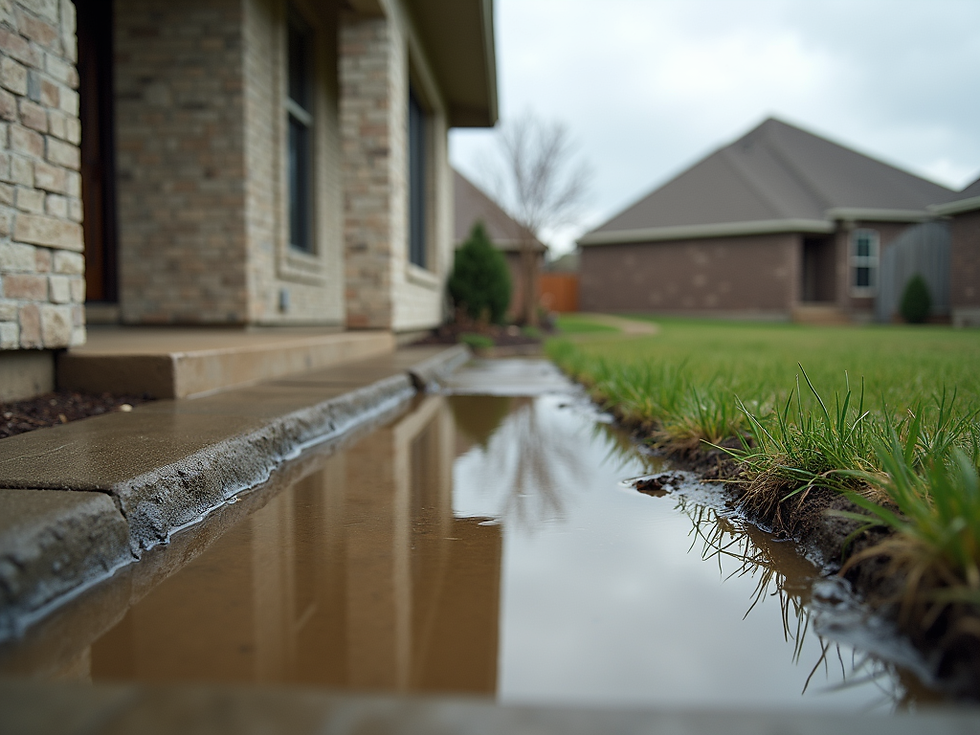
What Is Surface Drainage, and Which Type Does Your Austin Property Need?
Surface drainage is any system that collects rainwater on top of the ground and moves it off the property before it can pool, soak in where it shouldn't, or reach the foundation. The main types are grading, swales, channel (trench) drains, catch basins, and downspout extensions with pop-up emitters. Most Austin properties need a combination, chosen by where the water lands and where it can be sent.
Scott Lockhart Drainage Contractor has designed and installed surface drainage across Austin and Central Texas since 1984, on more than 10,000 projects. Here's how each type works and where it fits.
Surface Drainage vs. Subsurface Drainage
The difference is where the water is when you catch it.
Surface drainage handles water moving across the ground: sheet flow across a lawn, runoff off a driveway, roof water from a downspout, water pooling on a patio.
Subsurface drainage handles water moving through the soil, below the surface. A French drain is the classic example.
In Central Texas this distinction matters more than in most places. Our clay soil absorbs water slowly, so during a hard rain most water stays on the surface and runs. That makes surface drainage the first line of defense on most Austin properties.
The Main Types of Surface Drainage
Grading
What it is: shaping the ground so it slopes away from the house and toward a safe exit. Where it works: everywhere. It's the foundation of every other system. The International Residential Code, which Austin adopts with local amendments, calls for the ground to fall at least 6 inches within the first 10 feet away from a foundation.
Watch for: grading that has settled over decades, or flower beds and patios built up against the house. More on yard drainage and regrading.
Swales
What it is: a shallow, gently sloped channel, usually grassed, that collects surface water and carries it somewhere useful.
Where it works: side yards, property lines, and large lawns where sheet flow crosses the yard during storms.
Why people like it: there's no pipe to clog, and you can see it working.
Channel Drains (Trench Drains)
What it is: a long, narrow channel set into a hard surface, covered by a grate, that catches water along a line.
Where it works: the edges of driveways, garage entrances, patios, and pool decks. Anywhere a large hard surface sheds water toward the house.
Watch for: grates clogged with leaves and silt. They need occasional clearing.
Catch Basins (Area Drains)
What it is: a box set at a low point with a grate on top, connected to a solid pipe that carries the water away. Where it works: natural low spots where water always collects, courtyards, and enclosed yards. Watch for: a basin is only as good as where its pipe ends up. It needs a real discharge point.
Downspout Extensions and Pop-Up Emitters
What it is: buried solid pipe that carries roof water from the downspout to a pop-up emitter in the lawn, well away from the house. Where it works: every house with gutters. Roof water is often the single largest volume of water landing at any one spot on a property. Watch for: emitters buried by mulch or grass, and pipes that discharge too close to the foundation.
Common Applications on Austin Properties
Problem | Usual surface drainage answer |
Water pooling against the foundation | Regrading plus downspout extensions |
Driveway sheds water into the garage | Channel drain across the driveway |
Patio or pool deck holds water | Channel drain at the low edge, or re-pitching the surface |
Low spot in the yard that stays wet | Catch basin with a solid discharge line |
Water crossing the yard from a neighbor's lot | Swale or catch basins along the property line |
Large paved commercial lots | Catch basins and storm lines sized for real storms |
If the water problem shows up after you add a surface, see why hardscaping should be built drainage-first. For larger sites, see commercial drainage solutions in Central Texas.
When Surface Drainage Isn't Enough
Surface systems handle the water you can see. When the problem is water already in the soil, such as a crawl space that stays damp or water rising along a foundation days after a storm, the answer usually pairs surface drainage with a subsurface system. On a few sites with no downhill exit at all, a sump pump finishes the job.
The right combination depends on one thing: following the water from where it lands to where it can leave. That's the first thing we do on every site.
Frequently Asked Questions
What is the most common type of surface drainage? Grading. Almost every other surface system depends on the ground being shaped to move water away from the house first.
Is a channel drain the same as a French drain? No. A channel drain catches water on the surface through a grate. A French drain collects water underground through gravel and perforated pipe. They solve different problems, and some properties need both.
Can surface drainage fix standing water in my yard? Often, yes. Most standing water in Austin yards comes from flat or reversed grading, low spots with no exit, or downspouts dumping into the lawn, and all of those are surface problems. See standing water causes and solutions.
How do I know which type I need? Watch your property during a rain, or take a short video. Where water collects and which way it moves usually points straight to the answer, and a free consultation confirms it.
Start With the Water
Call Scott directly for a free consultation: 512-790-8564 Scott Lockhart Drainage Contractor · Austin, Texas · Since 1984