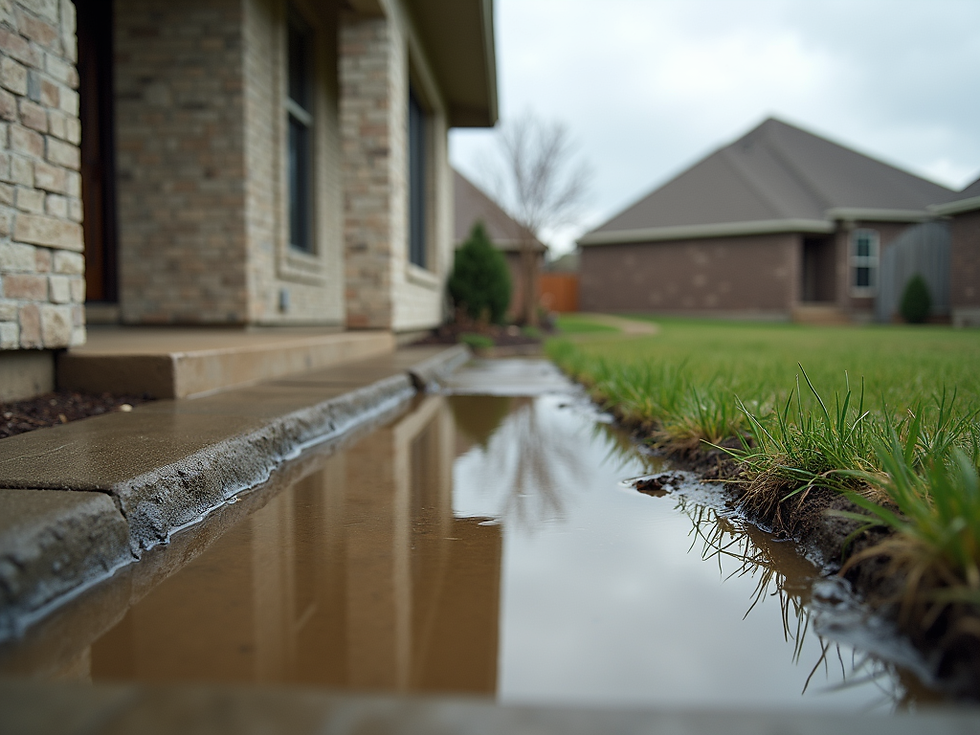
Why Your Austin Yard Keeps Flooding (and How a Drainage Specialist Fixes It)

There's nothing quite like the pit in your stomach when you look out the window — or into your garage, or worse, down at your flooring — and see pooled water after a storm. Whether it was a sudden summer flash flood, a relentless seasonal downpour, or a nearby creek that decided to breach its banks, home flooding is exhausting, stressful, and frankly a bit overwhelming.
Flooding is one of those homeowner headaches that always seems to happen at the worst possible time.
The truth is, flooding isn't always a freak weather event. A lot of the time, it's your property telling you it doesn't know what to do with water once it shows up. That's where a drainage specialist makes all the difference.
What Exactly Is a Drainage Specialist?
Think of a drainage specialist as part landscape architect, part water-flow problem solver, and part structural protector all rolled into one. Unlike a standard plumber who handles the pipes inside your walls, a drainage specialist focuses on how water moves around your property.
They analyze your yard, foundation, and topography to safely redirect water away from your home. After flooding, they investigate how water breached your defenses in the first place — and figure out how to keep it from happening again.
Flooding Is a Symptom, Not the Root Problem
When your yard floods, the standing water isn't really the issue. It's a sign that water has nowhere else to go. Several drainage problems can cause repeated flooding:
Poor yard grading
Clogged or undersized drainage systems
Compacted clay soil
Failing retaining walls
Improper gutter drainage
Broken underground drain pipes
Low spots that collect runoff
There's also the possibility that an older drainage system wasn't designed for the way your property has changed over the years. New patios, additions, even mature trees all change how water moves.
What a Drainage Specialist Actually Does After a Flood
One of the first things a drainage contractor does after flooding is perform a thorough inspection of your property. Rather than guessing, they'll evaluate how water naturally moves across your yard and identify the trouble spots.
They'll often check:
● Property slope and grading
● Standing water locations
● Existing drainage systems
● Downspout placement
● Erosion damage
● Foundation drainage
● Retaining walls
● Landscaping that may be blocking water flow
Sometimes the source of the flooding is surprisingly simple. Other times, several smaller issues combine to create one big problem.
Either way, identifying the cause is the first step toward fixing it for good.
Recommending the Right Drainage Solution
Once the water recedes, here's the kind of work that actually moves the needle:
Fixing the grade: Sometimes the fix isn't a pipe at all — it's dirt. Reshaping the slope of your yard so water flows away from your home instead of pooling against it can solve problems no amount of drainage hardware will fix on its own.
French drains: A gravel-filled trench containing a perforated pipe that redirects groundwater away from your foundation, quietly moving water to a safer discharge point.
Channel drains: These work well along driveways, patios, and walkways where surface water needs to be intercepted before it reaches the house.
Catch basins: Grated boxes installed at low points in your yard that catch rushing surface water before it puddles.
Downspout and gutter tie-ins: Extending and connecting downspouts into a proper drainage system is one of the simplest, highest-impact fixes out there.
Sump pumps: For low-lying properties or homes near creeks and greenbelts, a sump pump gives you an active line of defense when gravity alone isn't cutting it.
Foundation protection and waterproofing: When water sits against your foundation, it exerts constant pressure — and over time that pressure can force water through hairline cracks in the slab or exterior walls.
Why This Matters for Your Foundation
Standing water near your home isn't just inconvenient. It's one of the biggest threats to your foundation. Central Texas soil expands when wet and contracts when dry, and that constant swelling and shrinking is exactly what causes foundation cracks and shifts over time. Every flood that sits against your slab is another rep in that cycle.
Over time, that can lead to:
Foundation settling
Interior wall cracks
Sticking doors and windows
Uneven floors
Exterior brick cracks
A drainage specialist isn't just solving today's puddle problem — they're protecting the thing holding your house up.
Don't Wait for the Next Storm
It's tempting to deal with flooding only while it's happening, then forget about it the second the sun comes back out. Unfortunately, drainage problems don't fix themselves between storms. They just wait for the next one.
Most drainage problems are fixable, often without a huge overhaul. Don't let one storm become a recurring problem. Call Scott Lockhart Drainage Contractor at 512-790-8564 to schedule a drainage evaluation and take the first step toward keeping water where it belongs — away from your home.